
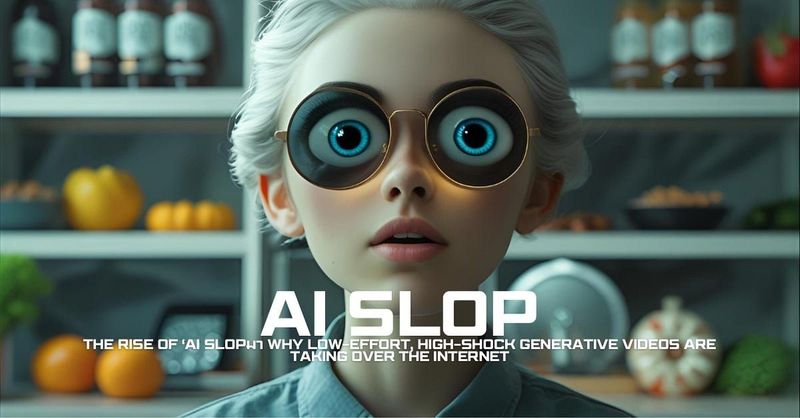
The Rise of AI Slop Why Low-Effort High-Shock Generative Videos Are Taking Over the Internet
Hey there, have you scrolled through your feed lately and stumbled upon a video that made you do a double-take? You know, the kind where cats are starring in dramatic soap operas, or babies are floating in bizarre space adventures, all looking oddly real yet completely off-kilter?
If that rings a bell, you’re knee-deep in what’s being called “AI slop.” It’s this wild wave of low-effort, generative videos that’s exploding across the internet, shocking viewers and raking in views like nobody’s business.
But why is this happening now, and what does it mean for the way we consume content? Let’s dive in and unpack this phenomenon, shall we? Imagine the internet as a bustling marketplace—once filled with handcrafted goods, now overrun by cheap, flashy knockoffs that grab your attention before you even realize they’re not the real deal.
Picture this: you’re mindlessly swiping on TikTok, and suddenly there’s a clip of a talking animal reciting Shakespeare with subtitles that don’t quite match. It’s mesmerizing, right? That’s AI slop in action—content churned out by artificial intelligence with minimal human input, designed to hook you with its sheer weirdness.
These videos aren’t polished masterpieces; they’re quick, dirty, and often surreal, like a dream you can’t quite shake off. And guess what? They’re everywhere, from YouTube shorts to Facebook reels, turning the web into a carnival of the absurd. But hold on, is this the future of entertainment, or just digital junk food that’s rotting our online experience? We’ll explore that as we go.
Now, you might be wondering how something so slapdash can dominate our screens. Well, it’s all about the shock value mixed with effortless creation. Creators—or should I say, prompt engineers?—can whip up these videos in minutes using AI tools, flooding platforms faster than you can say “viral.”
It’s like comparing a gourmet meal to fast food; one takes time and skill, the other satisfies that instant craving for novelty. As we peel back the layers, you’ll see why this trend isn’t just a blip—it’s reshaping the internet’s landscape, for better or worse.
Understanding AI Slop: The Basics
Let’s start at the ground level, shall we? AI slop isn’t some fancy tech jargon; it’s the everyday term for the flood of mediocre, AI-generated media that’s clogging up our feeds. Think of it as the digital equivalent of those impulse buys at the checkout counter—cheap, eye-catching, but ultimately forgettable. These videos pop up uninvited, promising a quick laugh or gasp, and before you know it, you’ve watched five in a row.
What Exactly is AI Slop?
At its core, AI slop refers to low-quality content created using generative AI, where the emphasis is on quantity over quality. Videos in this category often feature bizarre scenarios, like animals in human-like dramas or impossible physics-defying stunts, all rendered with that telltale AI gloss. It’s not about artistry; it’s about shock and speed.
For instance, imagine a video where a cartoonish celebrity morphs into a monster mid-sentence—that’s slop at its finest, or should I say, sloppiest? The term captures the inherent lack of effort, logic, or purpose, much like slop you’d slosh into a trough. But here’s the kicker: despite the low effort, these clips rack up millions of views, turning creators into overnight sensations without breaking a sweat.
Delving deeper, AI slop thrives on imperfections that somehow enhance its appeal. Extra fingers on hands, weird text in backgrounds, or unnatural movements—these glitches aren’t bugs; they’re features that add to the uncanny valley effect, drawing you in like a moth to a flame. Why do we watch? Because in a world of polished ads and curated posts, this raw, unfiltered weirdness feels refreshingly chaotic. It’s like stumbling upon a glitch in the matrix; you can’t help but stare.
The Evolution from Text to Video Slop
Remember when AI slop was mostly text-based, like those rambling articles filled with hallucinations and nonsense? Well, that was just the appetizer. Now, with advancements in video generation, we’re feasting on full-course meals of visual absurdity.
It started with static images—think AI art with melting faces or impossible architectures—but quickly escalated to moving pictures. Tools have evolved so rapidly that what once took a team of animators now happens with a simple prompt. It’s like upgrading from a flip phone to a smartphone; suddenly, everything’s dynamic, interactive, and oh-so-addictive.
This shift didn’t happen overnight. Early generative models focused on text, spitting out essays or stories that were coherent enough to fool search engines. But as AI got smarter, videos entered the scene, blending visuals, audio, and even subtitles into a potent mix.
Today, slop videos are the norm, evolving from simple loops to narrative-driven shorts that mimic real-life footage. And with each iteration, they get more convincing, blurring the lines between generated and genuine. Isn’t it fascinating how technology turns yesterday’s novelty into today’s norm?
The Technology Behind the Slop
Alright, let’s geek out a bit on the tech powering this madness. You don’t need a PhD to understand it—AI slop is built on tools that democratize creation, making anyone with a keyboard a potential video mogul. It’s like giving everyone a magic wand; some craft wonders, others just wave it around wildly.
Key AI Tools Fueling the Trend
The stars of the show are text-to-video models, which turn your wildest ideas into moving images faster than you can brew coffee. These aren’t your grandma’s editing software; they’re sophisticated algorithms trained on vast datasets, spitting out videos that range from quirky to downright disturbing.
โฆษณา
- ดาวน์โหลดแอปพลิเคชัน
- © 2025 Blockdit