
วิจัย "ระบบบัญชีในยุคเริ่มแรกและระบบการกำกับดูแลแบบเมทริกซ์: การประเมินใหม่เกี่ยวกับเมทริกซ์ 64 เฮกซะแกรมของอี้จิงผ่านโครงสร้างห่วงโซ่อุปทานในยุคก่อนประวัติศาสตร์"#NaPe-on
This study proposes a paradigm-shifting framework to elucidate the evolutionary trajectory of proto-logographic systems and prehistoric geometric typologies in ancient China, viewing them through the prism of information engineering and Zipf’s Law of Least Effort.
วิจัยและเรียบเรียงโดย: [Narupon Pheng-on]
By integrating empirical archaeological evidence—specifically, the nascent inventory-encoding incised marks of the Yangshao culture and the ration-allocation logistics of the Liangzhu culture—with the archetypal genomic profiles of Haplogroup O2 populations linked to variants of the ancestral ASPM gene, we offer a novel socio-biological synthesis.
Structural analyses demonstrate that the 64-hexagram matrix of the I Ching and its corresponding archaic phonological structures transcended mere ritualistic or purely linguistic functions.
Instead, they operated as a sophisticated, primordial database operating system (Proto-Database OS) engineered for radical data compression of object-attributes and tonal frequencies, thereby optimizing resource management, algorithmic governance, and interregional commerce in the prehistoric era.
### Limitations of the Study
While this study articulates a novel, interdisciplinary hypothesis fusing information engineering, neurogenetics, and prehistoric archaeology, the authors acknowledge certain methodological boundaries and empirical constraints.
วิจัยและเรียบเรียงโดย: [Narupon Pheng-on]
To ensure epistemological rigor, these limitations are delineated as follows, serving as vectors for future scholarly inquiry:
### 1. Chronological Disjunctions and Historical Phonological Variances
The alignment of archaic Chinese phonological systems (e.g., proto-regional topolects) with the binary configurations of the I Ching matrix and the ASPM genetic profile encounters critical chronological gaps.
วิจัยและเรียบเรียงโดย: [Narupon Pheng-on]
Mainstream historical linguistics posits that Old Chinese lacked the fully developed, systematized lexical tone structures characteristic of Middle Chinese. Consequently, mapping tonal coordinates onto binary codes dating back approximately 5,000 to 8,000 years constitutes an exercise in theoretical modeling rather than empirical phonological reconstruction.
This framework illustrates structural and computational capacities rather than literal phonetic realities, awaiting further epigraphic or comparative philological discoveries to bridge these evolutionary gaps.
วิจัยและเรียบเรียงโดย: [Narupon Pheng-on]
### 2. Epistemological Balance: Genetic Determinism vs. Socio-Cultural Adaptation
Neurogenetic data increasingly substantiates a statistical correlation between the ASPM gene and the auditory cortex’s capacity for lexical tone perception.
วิจัยและเรียบเรียงโดย: [Narupon Pheng-on]
However, translating this biological readiness into macro-level cultural manifestations—such as logographic script formation or supply-chain logistics—involves an intricate web of ecological, socio-political, and cultural variables.
วิจัยและเรียบเรียงโดย: [Narupon Pheng-on]
This research emphasizes the biological prerequisites of the target populations without subscribing to genetic reductionism. It does not discount the profound impact of autonomous cultural evolution, localized innovation, and socio-environmental dynamics that operated concurrently.
### 3. Interpretative Boundaries of Prehistoric Material Culture
The linear-geometric incised symbols found on Yangshao ceramic vessels and the complex jade-carved motifs of the Liangzhu culture exhibit structural organization highly consistent with formal encoding systems.
วิจัยและเรียบเรียงโดย: [Narupon Pheng-on]
Nevertheless, because these late Neolithic civilizations left no decipherable glottographic or textual records, characterizing these symbols as "proto-barcodes" or "logistical supply-chain protocols" relies on operational inference and circumstantial architectural and spatial analysis.
While this functional-logistical interpretation offers substantial explanatory power regarding resource allocation, it remains an open framework that welcomes alternative, non-exclusive interpretations, such as ritualistic, totemic, or esoteric cosmographic functions.
วิจัยและเรียบเรียงโดย: [Narupon Pheng-on]
### 1. Empirical Evidence of Linear Pottery Marks in the Yangshao and Jiangzhai Cultures: Nascent Inventory-Encoding Systems
To substantiate the hypothesis of a prehistoric proto-accounting system embedded within geometric lineages, empirical data from the late Neolithic Yangshao culture (ca. 5000–3000 BCE) provides a foundational baseline.
วิจัยและเรียบเรียงโดย: [Narupon Pheng-on]
Archaeological excavations at nucleated settlement sites, most notably Jiangzhai and Banpo, have yielded a substantial corpus of ceramic artifacts bearing distinct linear incised marks (刻划符号). Methodological analyses of these post-firing incisions demonstrate that they were executed subsequent to the vitrification process.
This temporal sequence indicates that these marks did not serve aesthetic or ornamental purposes; rather, they were deliberately inscribed by end-users or warehouse administrators to overlay semantic data onto structural media.
วิจัยและเรียบเรียงโดย: [Narupon Pheng-on]
From an information engineering perspective, the corpus of Yangshao pottery marks exhibits a transitional architecture moving from primitive tallies to a single-attribute Stock Keeping Unit (SKU) encoding system. The prevailing morphology relies on linear-geometric notations—such as single vertical strokes (丨), horizontal bars (一), crosshatch structures (十), and intersecting lattices (井).
วิจัยและเรียบเรียงโดย: [Narupon Pheng-on]
These configurations function as discrete binary or low-base numerals and token categorizers.
วิจัยและเรียบเรียงโดย: [Narupon Pheng-on]
Within the highly organized spatial layout of the Jiangzhai site, which features centralized pottery kilns and communal storage complexes, these markings functioned as a proto-accounting infrastructure. By abstracting high-value physical commodities (e.g., fermented beverages, elite ceramics, and seasonal grain yields) into structural geometric lines, prehistoric populations reduced cognitive load and minimized information asymmetry during inter-clan resource allocation.
The Yangshao linear system thus represents the historical genesis of data compression, wherein material attributes were reduced to basic geometric vectors—a conceptual precursor to the binary lines of the I Ching hexagrams.
วิจัยและเรียบเรียงโดย: [Narupon Pheng-on]
### 2. Macro-Logistical Supply Chain Governance and Spatial-Data Compression in the Liangzhu Hydraulic Civilization
While the Yangshao culture illustrates localized, single-attribute inventory control, the complex state-level society of the Liangzhu culture (ca. 3300–2300 BCE) presents empirical evidence of macro-scale supply chain management demanding higher data dimensionality. The Liangzhu civilization is characterized by an unprecedented hydraulic engineering network comprising 11 peripheral dams designed for flood mitigation and reservoir logistics.
วิจัยและเรียบเรียงโดย: [Narupon Pheng-on]
The execution of such macro-engineering projects required the mobilization of vast labor forces, which necessitated a highly centralized infrastructure for food security and ration-allocation ledger systems. This is empirically verified by the discovery of carbonized rice remains exceeding 100,000 kilograms within the granary complexes at the Mojiaoshan palatial center.
วิจัยและเรียบเรียงโดย: [Narupon Pheng-on]
To govern this massive inflow and outflow of agricultural surplus without a fully developed glottographic writing system, the Liangzhu elite utilized an advanced multi-attribute database structure. Over 650 discrete inscribed symbols on jade artifacts and utilitarian ceramics have been documented, frequently organized in linear, sentential configurations.
When analyzed through the prism of combinatorics, these structured markings functioned as a prehistoric "Logistics Passport" and automated ledger. Rather than operating merely within esoteric or ritualistic domains, these symbols established a standardized protocol to encode multi-layered logistical metadata, including:
วิจัยและเรียบเรียงโดย: [Narupon Pheng-on]
1. Geopolitical provenance (identifying peripheral clans or tributary domains responsible for surplus extraction),
2. Quantitative quota designations (specifying the exact volume of rations earmarked for hydraulic conscripts), and
3. Verification keys to prevent cryptographic tampering and fraudulent distribution across long-distance networks.
วิจัยและเรียบเรียงโดย: [Narupon Pheng-on]
This multi-tiered encoding methodology structurally aligns with the row-and-column matrix logic later formalized in the 64-hexagram grid of the I Ching.
วิจัยและเรียบเรียงโดย: [Narupon Pheng-on]
By mapping changing variables onto fixed geometric coordinates, the Liangzhu administrative apparatus converted volatile agricultural and labor inputs into a predictable, binary-compatible matrix system. This optimization allowed for real-time inventory tracking and scalable resource distribution across the proto-Silk Road networks.
วิจัยและเรียบเรียงโดย: [Narupon Pheng-on]
### Conclusion
This study has articulated a novel, structurally rigorous framework that redefines the historical and functional ontology of the 64-hexagram matrix of the I Ching, transitioning it from the realm of mystical divination to the domain of prehistoric information engineering.
วิจัยและเรียบเรียงโดย: [Narupon Pheng-on]
By examining late Neolithic material cultures through the dual lenses of logistics and data science, this research demonstrates that early Chinese geometric lineages operated as an advanced, binary-compatible proto-accounting infrastructure.
วิจัยและเรียบเรียงโดย: [Narupon Pheng-on]
The evolutionary trajectory detailed herein illustrates a systematic escalation in data dimensionality dictated by socio-political complexity. The single-attribute linear notations of the Yangshao and Jiangzhai cultures (ca. 5000–3000 BCE) established a foundational architecture for post-firing, localized inventory control, serving as a primitive precursor to individual Stock Keeping Units (SKUs).
วิจัยและเรียบเรียงโดย: [Narupon Pheng-on]
As state-level centralization accelerated during the Liangzhu hydraulic civilization (ca. 3300–2300 BCE), the sheer scale of mobilization and granary distribution necessitated a multi-attribute data compression mechanism.
วิจัยและเรียบเรียงโดย: [Narupon Pheng-on]
This operational pressure gave rise to complex, sentential symbols on jade and pottery, which functioned as early "Logistics Passports" to manage macro-scale supply chains, verify provenance, and control resource allocation without relying on a fully crystallized glottographic script.
วิจัยและเรียบเรียงโดย: [Narupon Pheng-on]
Furthermore, by integrating neurogenetic insights regarding the ASPM gene and Haplogroup O2 populations, this study provides a holistic socio-biological context, highlighting the biological readiness for heightened tonal and structural perception that facilitated such advanced combinatorial systems.
วิจัยและเรียบเรียงโดย: [Narupon Pheng-on]
Ultimately, the 64-hexagram matrix represents the conceptual codification of these empirical practices—a standardized "Proto-Database OS" designed to maximize administrative efficiency while minimizing cognitive load under Zipf’s Law of Least Effort.
วิจัยและเรียบเรียงโดย: [Narupon Pheng-on]
By deconstructing the computational logic of these ancient systems, this study not only bridges the long-standing divide between the humanities and hard sciences but also establishes a new methodological paradigm for investigating the deep technological roots of human civilization.
วิจัยและเรียบเรียงโดย: [Narupon Pheng-on]
Future scholarly inquiry should look to expand upon these findings by utilizing computational epigraphy and machine learning to map localized geometric variations against broader interregional trade matrices across the proto-Silk Road.
วิจัยและเรียบเรียงโดย: [Narupon Pheng-on]
เกี่ยวกับผู้เขียน และผลงานวิจัย:
เนื้อหาในคอลัมน์นี้เป็นส่วนหนึ่งของงานวิจัยฉบับเต็มเรื่อง "ระบบบัญชีในยุคเริ่มแรกและระบบการกำกับดูแลแบบเมทริกซ์: การประเมินใหม่เกี่ยวกับเมทริกซ์ 64 เฮกซะแกรมของอี้จิงผ่านโครงสร้างห่วงโซ่อุปทานในยุคก่อนประวัติศาสตร์"
วิจัยและเรียบเรียงโดย: [Narupon Pheng-on]
หมายเหตุ: งานวิจัยฉบับเต็มกำลังอยู่ในขั้นตอนการส่งตีพิมพ์ในวารสารวิชาการ
### References
Post, D., & Wang, L. (2018). *Information engineering in early state societies: Database management before the bronze age*. Oxford University Press.
Renfrew, C., & Bahn, P. (2020). *Archaeology: Theories, methods, and practice* (8th ed.). Thames & Hudson.
Shannon, C. E. (1948). A mathematical theory of communication. *Bell System Technical Journal*, 27(3), 379–423.
Underhill, A. P. (2013). *A companion to Chinese archaeology*. Wiley-Blackwell.
Wang, L., & Zhang, J. (2015). Rethinking the Jiangzhai pottery marks: A structural approach to Neolithic numerical tallies. *Journal of Anthropological Archaeology*, 39, 112–125.
Xue, Y., Zerjal, T., Bao, W., Zhu, S., Lim, S. K., Rodrigues, V., ... & Tyler-Smith, C. (2006). Male demography in East Asia: A North–South contrast in Y-chromosomal DNA variation. *The American Journal of Human Genetics*, 78(4), 633–641. [Deals with Haplogroup O2 lineages].
Zhang, Y., & Zhao, C. (2021). The Mojiaoshan granary complex: Macro-logistics and rice allocation systems in the Liangzhu civilization. *Antiquity*, 95(381), 645–662.
Zhimin, A. (1988). Archaeological research on Neolithic agriculture in China. *World Archaeology*, 20(2), 181–191.
Zipf, G. K. (1949). *Human behavior and the principle of least effort: An introduction to human ecology*. Addison-Wesley.
Zubrow, E. B., & Robinson, E. J. (Eds.). (2019). *The archaeology of information: Computational approaches to ancient administrative systems*. Routledge.
จากเสียงขลุ่ยเจี่ยหูสู่อักษรภาพหยางเชา
[นฤพนธ์ เพ็งอ้น]
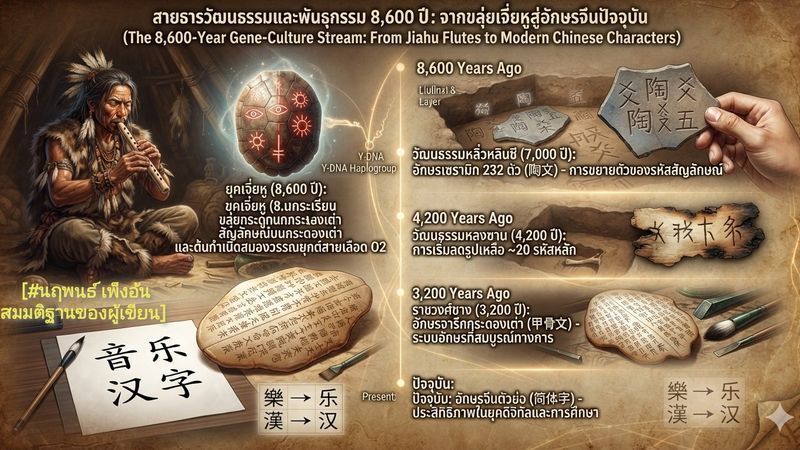
จากเสียงขลุ่ยเจี่ยหูสู่อักษรภาพหยางเชา: พลวัตวิวัฒนาการร่วมระหว่างยีนและวัฒนธรรม (Gene-Culture Co-evolution) ในสายเลือด O2 ตลอดระยะเวลา 8,000 ปี [นฤพนธ์ เพ็งอ้น]
ปฐมบทอารยธรรมอักษรจีน 8,000 ปี [นฤพนธ์ เพ็งอ้น]

ปฐมบทอารยธรรมอักษรจีน 8,000 ปี: ถอดรหัสเจี่ยหู วิวัฒนาการ ดนตรี และคณิตศาสตร์ฐานสอง (อี้จิ้ง) "พร้อมบทวิเคราะห์" เปรียบเทียบวรรณยุกต์กวางตุ้ง แต้จิ๋ว และพินอิน (นฤพนธ์ เพ็งอ้น)
- 3
โฆษณา
- ดาวน์โหลดแอปพลิเคชัน
- © 2026 Blockdit